
 EN
EN



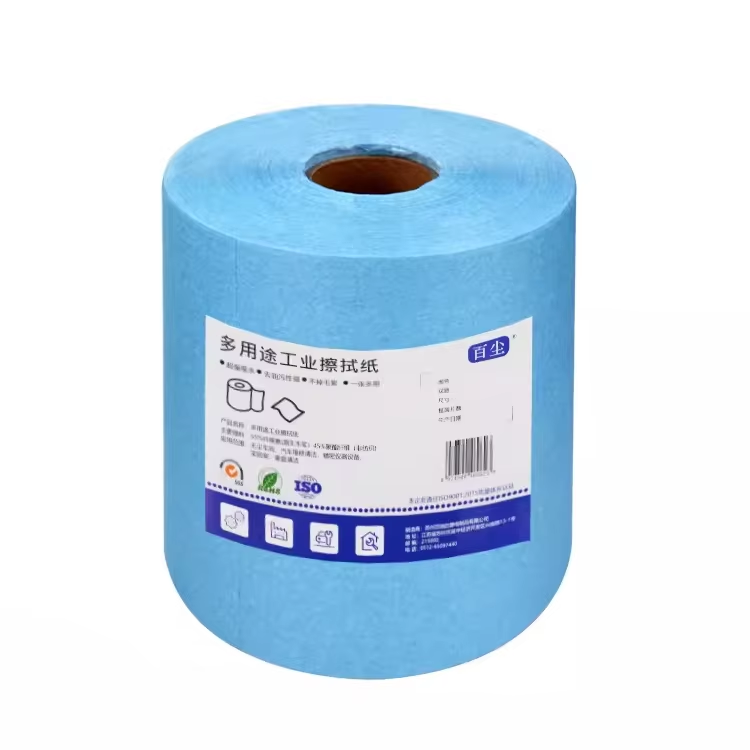
In today's precision manufacturing landscape, maintaining contamination-free environments has become more critical than ever before. Industries ranging from semiconductor fabrication to pharmaceutical production depend on ultra-clean conditions to ensure product quality and operational efficiency. One fundamental component of these controlled environments is dust free paper, a specialized material engineered to minimize particle generation while providing superior cleaning and wiping capabilities. The importance of selecting appropriate cleaning materials cannot be overstated when dealing with sensitive manufacturing processes where even microscopic contaminants can result in costly defects or product failures.
Understanding the Science Behind Contamination Control
Particle Generation in Traditional Materials
Conventional paper products and cloth materials pose significant challenges in precision manufacturing environments due to their inherent tendency to shed fibers and generate particles. When regular paper towels or cotton cloths are used for cleaning or wiping operations, microscopic fragments continuously detach from the material's surface, creating airborne contaminants that can settle on sensitive equipment or work surfaces. These particles, often measuring between 0.5 to 50 micrometers, become problematic in industries where cleanliness standards require particle counts below specific thresholds.
The structure of traditional paper consists of loosely bound cellulose fibers held together by lignin and other natural binding agents. During use, mechanical stress from wiping motions causes these fibers to break away, particularly at the edges where cutting has disrupted the material's integrity. This phenomenon becomes even more pronounced when the material absorbs liquids, as moisture can weaken the fiber bonds and increase particle generation rates significantly.
Advanced Material Engineering Solutions
Modern dust free paper utilizes sophisticated manufacturing processes that fundamentally alter the material's structure to minimize particle generation. These products typically employ synthetic fibers or specially processed natural fibers that are bonded using thermal or chemical techniques rather than traditional mechanical binding methods. The result is a material with superior structural integrity that maintains its cleanliness properties throughout its useful life.
Edge sealing technologies represent another crucial advancement in dust free paper manufacturing. By thermally sealing or chemically treating the edges of each sheet, manufacturers prevent the fiber separation that typically occurs along cut lines. This edge treatment significantly reduces particle generation from what would otherwise be the most vulnerable areas of the material, ensuring consistent performance across the entire sheet surface.
Critical Applications in Manufacturing Industries
Semiconductor and Electronics Manufacturing
The semiconductor industry represents perhaps the most demanding application environment for dust free paper, where cleanroom classifications can require particle counts as low as one particle per cubic foot for particles larger than 0.1 micrometers. In these environments, traditional cleaning materials would immediately compromise the controlled atmosphere, potentially causing defects in microprocessor fabrication or memory chip production. Specialized dust free paper enables technicians to perform essential cleaning tasks without introducing contamination that could affect yield rates or product reliability.
Circuit board assembly operations also benefit significantly from dust free paper applications, particularly during flux removal and component cleaning processes. The precision required in modern electronics manufacturing demands materials that can effectively remove residues and contaminants without leaving behind particles that might interfere with electrical connections or component functionality. The non-shedding properties ensure that cleaning operations enhance rather than compromise the cleanliness of sensitive electronic assemblies.
Pharmaceutical and Biotechnology Production
Pharmaceutical manufacturing facilities operate under strict regulatory guidelines that mandate specific cleanliness standards throughout production processes. Dust free paper plays a vital role in these environments by enabling thorough cleaning and sanitization procedures without introducing contaminants that could affect drug purity or potency. The material's compatibility with various cleaning solvents and disinfectants makes it particularly valuable for routine maintenance and cleaning protocols.
Biotechnology laboratories conducting research and development activities require materials that maintain sterile conditions while providing effective cleaning capabilities. The use of dust free paper helps prevent cross-contamination between different research projects and ensures that sensitive biological samples remain uncompromised by airborne particles that could interfere with experimental results or analysis procedures.

Performance Characteristics and Technical Specifications
Absorption and Liquid Handling Properties
High-quality dust free paper exhibits exceptional absorbency characteristics that enable efficient removal of liquids, oils, and other substances commonly encountered in manufacturing environments. The engineered fiber structure creates capillary channels that rapidly draw liquids into the material while maintaining structural integrity throughout the absorption process. This performance ensures that cleaning operations can be completed effectively without requiring excessive quantities of material or repeated applications.
The liquid retention properties of dust free paper also contribute to its effectiveness in controlling contamination spread. By quickly absorbing spilled substances and preventing them from dispersing across work surfaces, these materials help maintain the controlled environment essential for precision manufacturing operations. The ability to contain and remove various types of liquids makes dust free paper particularly valuable in environments where multiple chemical processes occur simultaneously.
Chemical Compatibility and Resistance
Manufacturing environments often involve exposure to aggressive chemicals, solvents, and cleaning agents that can degrade conventional materials. Advanced dust free paper formulations incorporate chemical-resistant fibers and binding agents that maintain their integrity when exposed to common industrial chemicals. This resistance ensures that the material continues to perform its intended function without breaking down or releasing particles when used with harsh cleaning compounds.
The pH stability of quality dust free paper enables its use across a wide range of chemical environments, from highly acidic to strongly alkaline conditions. This versatility makes it suitable for diverse manufacturing processes where different chemical treatments or cleaning protocols may be required. The consistent performance across various chemical exposures provides manufacturing facilities with a reliable cleaning solution that maintains its effectiveness regardless of the specific substances involved.
Implementation Strategies for Manufacturing Facilities
Cleanroom Classification Considerations
Different cleanroom classifications require specific approaches to dust free paper selection and implementation. Class 100 cleanrooms, which allow no more than 100 particles of 0.5 micrometers or larger per cubic foot, demand the highest grade materials with proven non-shedding characteristics and extensive validation testing. Facilities operating at these stringent levels must carefully evaluate particle generation data and certification documentation to ensure compliance with their cleanliness requirements.
Lower classification cleanrooms, such as Class 1000 or Class 10000 environments, may utilize dust free paper with slightly different specifications while still maintaining the essential non-shedding properties. The selection process should consider not only the immediate particle generation characteristics but also the long-term performance under various usage conditions and environmental factors that may affect material behavior over time.
Training and Procedural Integration
Successful implementation of dust free paper requires comprehensive training programs that educate personnel on proper handling, storage, and usage techniques. Workers must understand the importance of maintaining material integrity during use and recognizing signs of potential contamination or degradation that could compromise cleaning effectiveness. Proper training ensures that the investment in high-quality materials translates into measurable improvements in manufacturing environment cleanliness.
Standard operating procedures should incorporate specific guidelines for dust free paper usage, including storage requirements, handling protocols, and disposal methods. These procedures help maintain consistency across different shifts and personnel while ensuring that the material's contamination control properties are preserved throughout its lifecycle. Regular auditing and compliance monitoring further reinforce proper usage practices and identify areas for improvement in implementation strategies.
Economic and Operational Benefits
Cost-Effectiveness Analysis
While dust free paper typically commands a higher initial cost compared to conventional cleaning materials, the total cost of ownership often proves significantly lower when factoring in the avoided costs of contamination-related issues. Product defects, equipment downtime, and rework expenses associated with contamination events can far exceed the premium paid for high-quality cleaning materials. Manufacturing facilities that implement comprehensive contamination control programs using dust free paper frequently report improved yield rates and reduced quality-related expenses.
The efficiency gains achieved through effective contamination control extend beyond immediate manufacturing operations to include reduced maintenance requirements, longer equipment life, and improved process reliability. These secondary benefits contribute to the overall economic justification for investing in premium cleaning materials and help manufacturing facilities achieve better financial performance through operational excellence.
Quality Assurance and Regulatory Compliance
Regulatory agencies in industries such as pharmaceuticals, medical devices, and aerospace manufacturing increasingly scrutinize contamination control practices as part of their oversight responsibilities. The use of properly validated dust free paper helps facilities demonstrate their commitment to maintaining appropriate cleanliness standards and provides documentation that supports regulatory compliance efforts. This compliance value becomes particularly important during facility inspections or audit procedures where contamination control practices receive detailed examination.
Quality assurance programs benefit from the consistent performance characteristics of high-quality dust free paper, which provides reliable results that support statistical process control initiatives. The predictable behavior of these materials enables quality teams to establish meaningful control limits and identify variations that might indicate process issues or environmental changes requiring attention.
Future Developments and Industry Trends
Advanced Material Technologies
Research and development efforts in dust free paper technology continue to focus on enhancing performance characteristics while reducing environmental impact. New fiber technologies and bonding methods promise even lower particle generation rates and improved chemical resistance properties. These advances will enable manufacturing facilities to achieve higher levels of cleanliness while potentially reducing material consumption through improved efficiency.
Nanotechnology applications in dust free paper manufacturing represent an emerging area of innovation, with researchers exploring how nanoscale material modifications can enhance absorption, durability, and contamination control properties. These developments may lead to next-generation products that offer superior performance characteristics while maintaining compatibility with existing cleaning protocols and procedures.
Sustainability and Environmental Considerations
Environmental sustainability has become an increasingly important factor in material selection decisions, driving development of dust free paper products that incorporate recycled content or biodegradable components without compromising performance. Manufacturers are exploring renewable fiber sources and environmentally friendly production processes that reduce the ecological footprint of these essential materials while maintaining the stringent quality standards required for precision manufacturing applications.
Waste reduction initiatives in manufacturing facilities are also influencing dust free paper product development, with emphasis on creating materials that provide longer service life or enable more efficient usage patterns. These improvements help facilities reduce disposal costs and environmental impact while maintaining the cleanliness standards essential for their operations.
FAQ
What makes dust free paper different from regular paper towels
Dust free paper is manufactured using specialized processes that prevent fiber shedding and particle generation during use. Unlike regular paper towels, which are made from loosely bound cellulose fibers that easily separate during wiping, dust free paper employs synthetic fibers or specially treated natural fibers with enhanced bonding techniques. Edge sealing treatments further prevent particle generation from cut edges, ensuring the material maintains its cleanliness properties throughout its useful life.
How do I choose the right grade of dust free paper for my application
Selection depends on your specific cleanroom classification and contamination control requirements. Class 100 cleanrooms require the highest grade materials with extensive particle generation testing and validation documentation. Less stringent environments may use materials with slightly relaxed specifications while still maintaining non-shedding properties. Consider factors such as chemical compatibility, absorption requirements, and usage conditions when making your selection.
Can dust free paper be used with all types of cleaning solvents
High-quality dust free paper is designed to be compatible with most common industrial cleaning solvents and chemicals. However, specific chemical resistance varies between different product formulations. Always verify compatibility with your intended solvents by consulting manufacturer specifications or conducting compatibility testing. Materials with enhanced chemical resistance are available for applications involving aggressive solvents or extreme pH conditions.
What is the typical shelf life of dust free paper products
Most dust free paper products have indefinite shelf life when stored properly in controlled environmental conditions. However, packaging integrity is crucial for maintaining cleanliness properties. Store materials in their original sealed packaging, away from direct sunlight, extreme temperatures, and high humidity conditions. Once packaging is opened, use materials promptly to prevent contamination from environmental exposure that could compromise their performance characteristics.